Last updated October 30, 2026
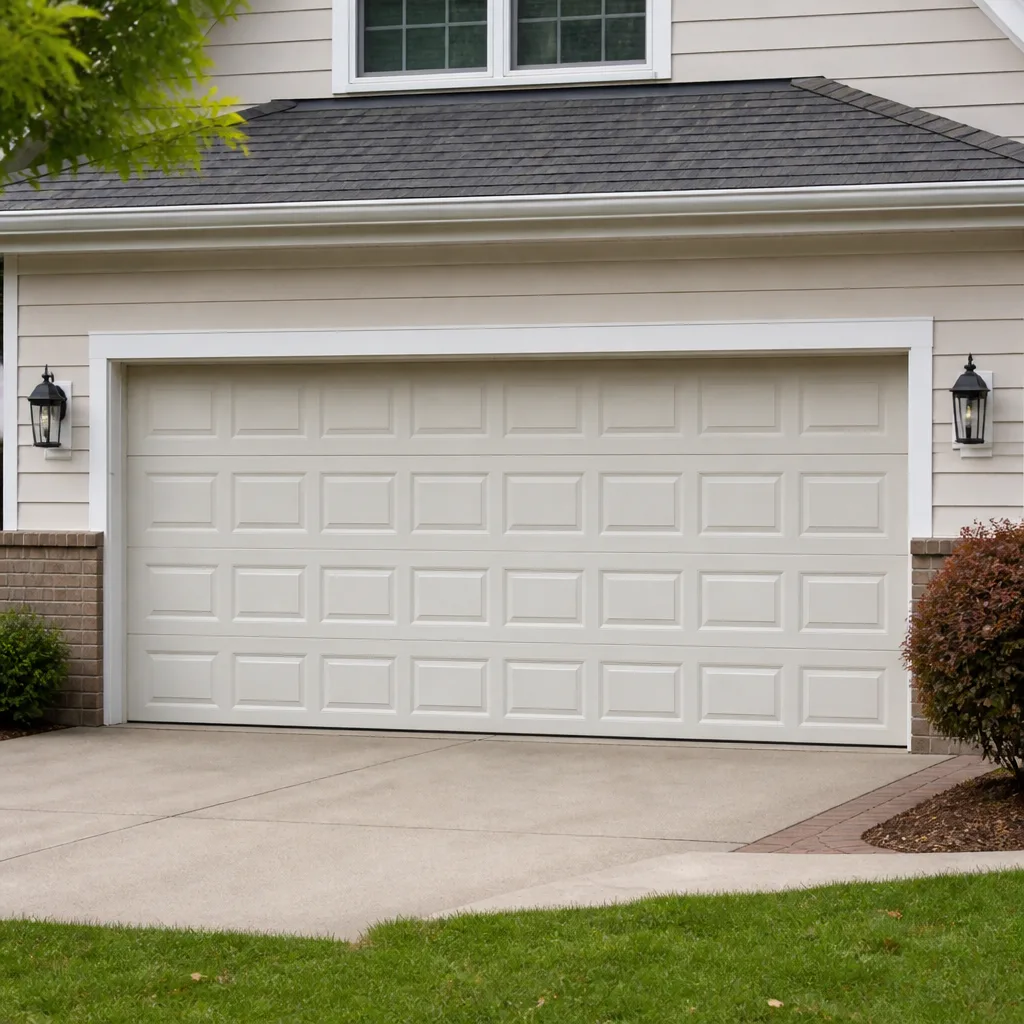 Raised-panel steel
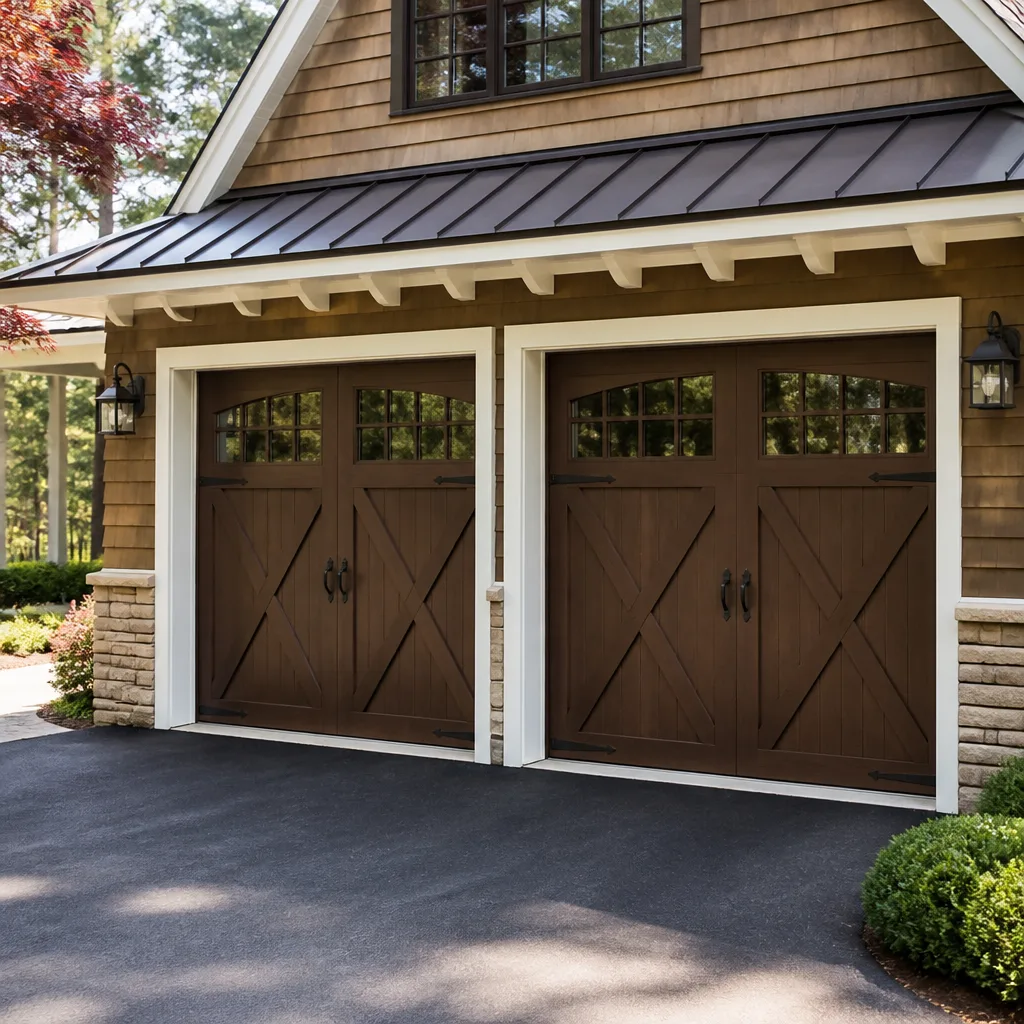 Carriage house
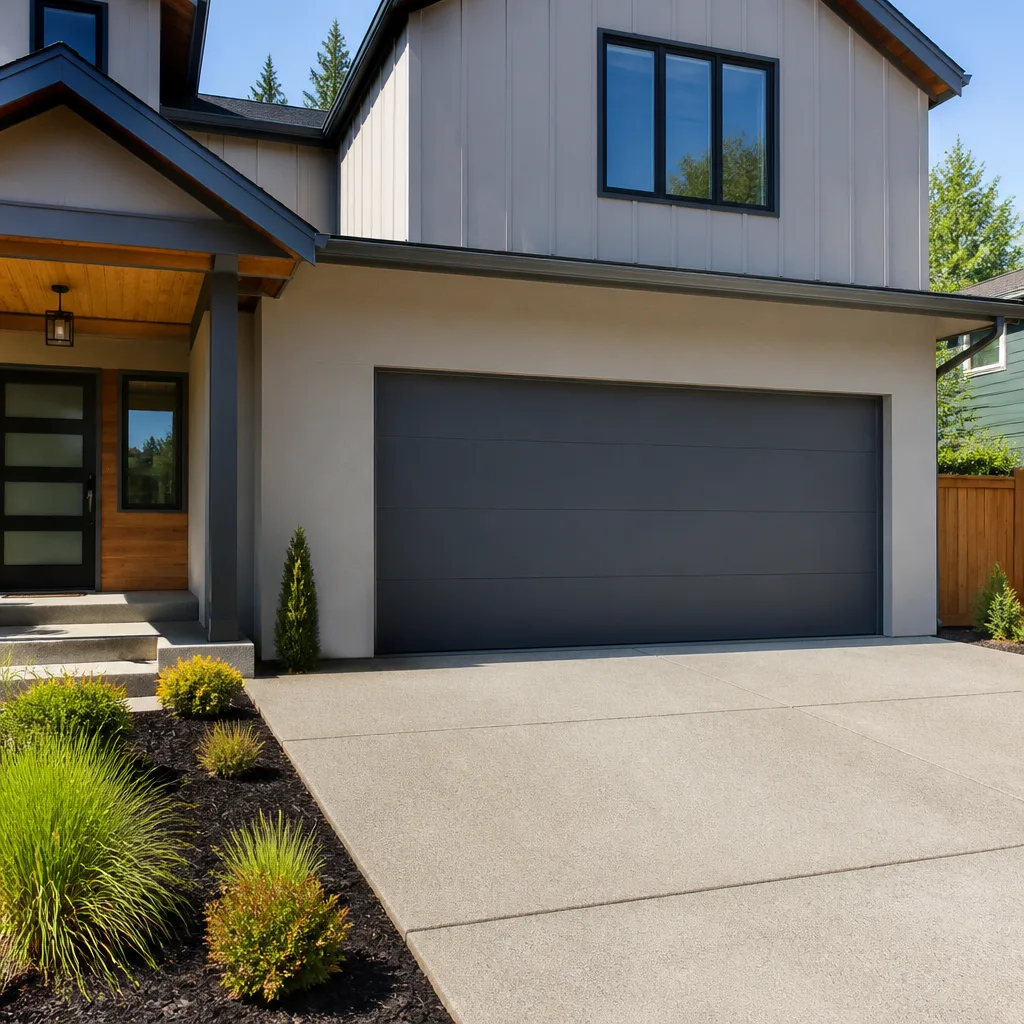 Modern flush
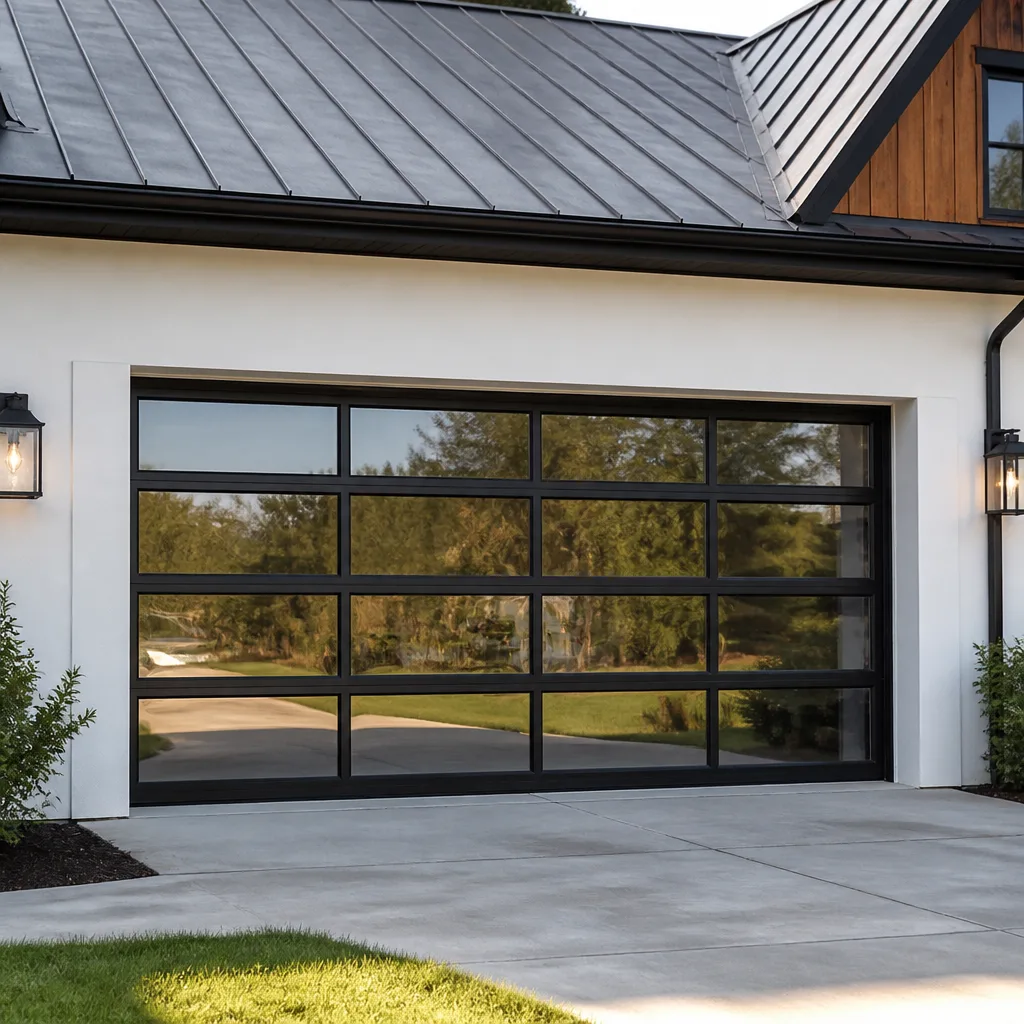 Full-view glass
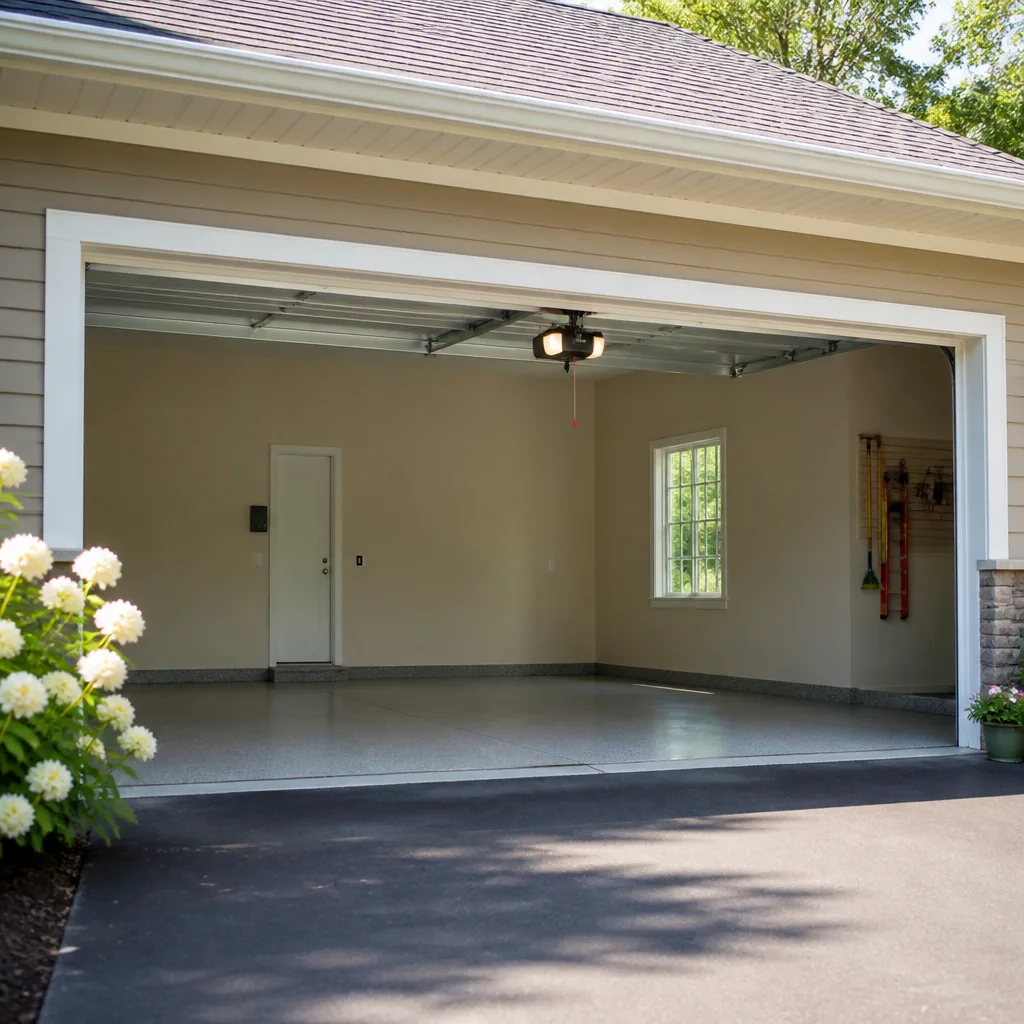 LiftMaster openers
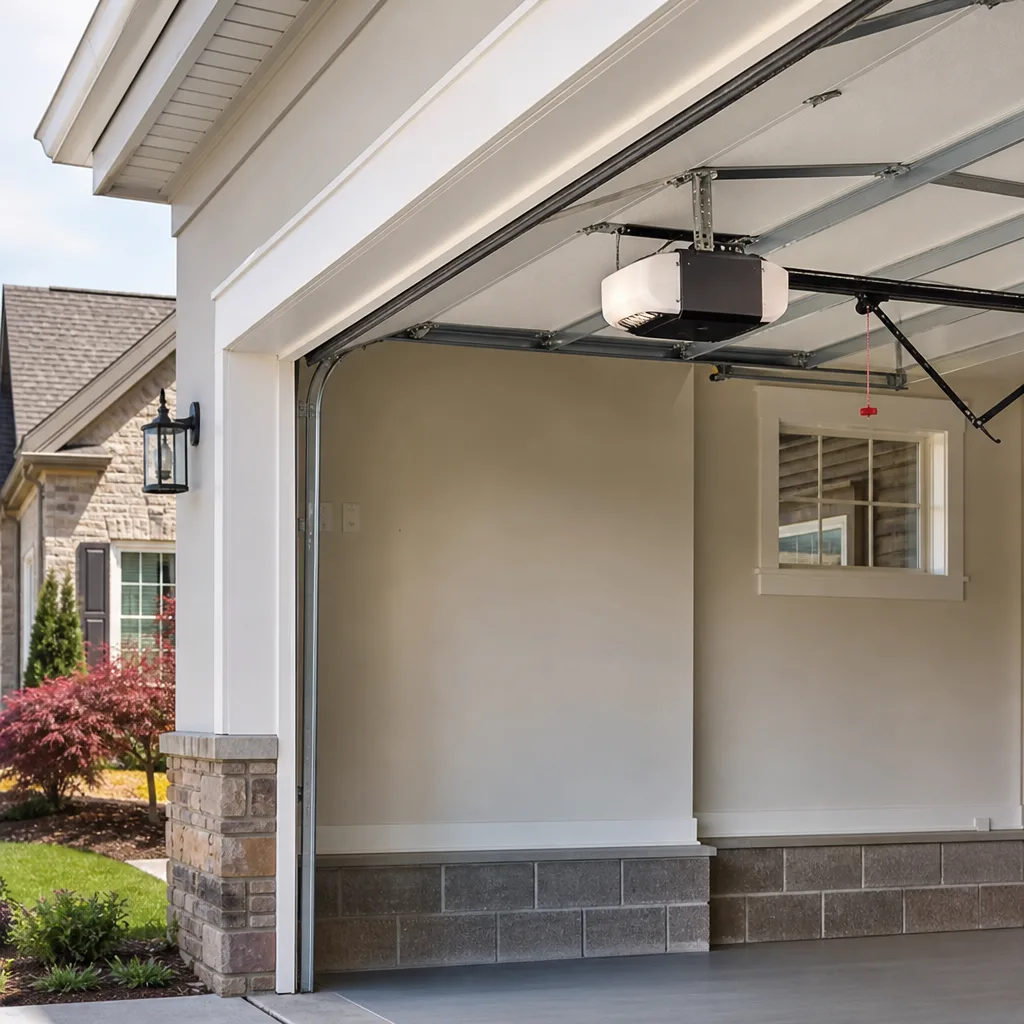 Chamberlain openers
Full 25-point door and opener safety check with every visit - springs, cables, rollers, tracks, and your LiftMaster or Chamberlain opener included
You get a price before we start. It does not change when the truck arrives.
Get your free estimateThe Complete Guide to Garage Door in Alief
Most garage door guides read like they were written for Phoenix or Minneapolis. Alief is neither. This unincorporated Harris County community sits in USDA Hardiness Zone 9a with 60-plus inches of annual rainfall and summer humidity that rarely dips below 70 percent. Those conditions do specific things to garage door hardware: torsion springs corrode from the inside out, steel panels rust along the bottom rails, and opener circuit boards fail earlier than their national average lifespan of 10 to 12 years. This guide maps every component, failure mode, and decision point a Alief homeowner will actually face, from first symptom to final repair or replacement call, with more guides & resources available for ongoing maintenance.
Quick Answer
A garage door in Alief is a system of interrelated parts – panels, springs, cables, rollers, tracks, opener, and seals – where any single failure can disable the entire door. The two components that fail most in this climate are torsion springs (which last 8,000 to 12,000 cycles, roughly 7 to 10 years of Alief-level use) and bottom seals (which Gulf Coast humidity and flooding scouring destroy within 2 to 3 years). Most mid-life failures are repairable; a full replacement only makes sense when the door has structural rust, warped panels, or is older than 15 years with multiple simultaneous failures.
Styles & brands we work with
Table of Contents
- The Anatomy of a Alief Garage Door System
- How Gulf Coast Humidity Attacks Your Door
- Repair vs. Replace: The Alief Cost-Benefit Math
- Door Materials That Survive Alief Weather
- Torsion Springs: The Component That Everything Depends On
- Garage Door Openers in a Humid Climate
- Security and Energy Efficiency in Slab-Foundation Homes
- Common Mistakes to Avoid
- When to Call a Professional
- Frequently Asked Questions
The Anatomy of a Alief Garage Door System
Before you can diagnose a problem, you need to know what you’re looking at. A residential garage door in Alief is not one object. It’s a system of six distinct component groups working together. When one group fails, it often stresses the others, which is why a broken spring today frequently becomes a burned-out opener motor next month if ignored.
Here’s what’s actually on the other side of that door, in the order you’ll encounter it during a repair:
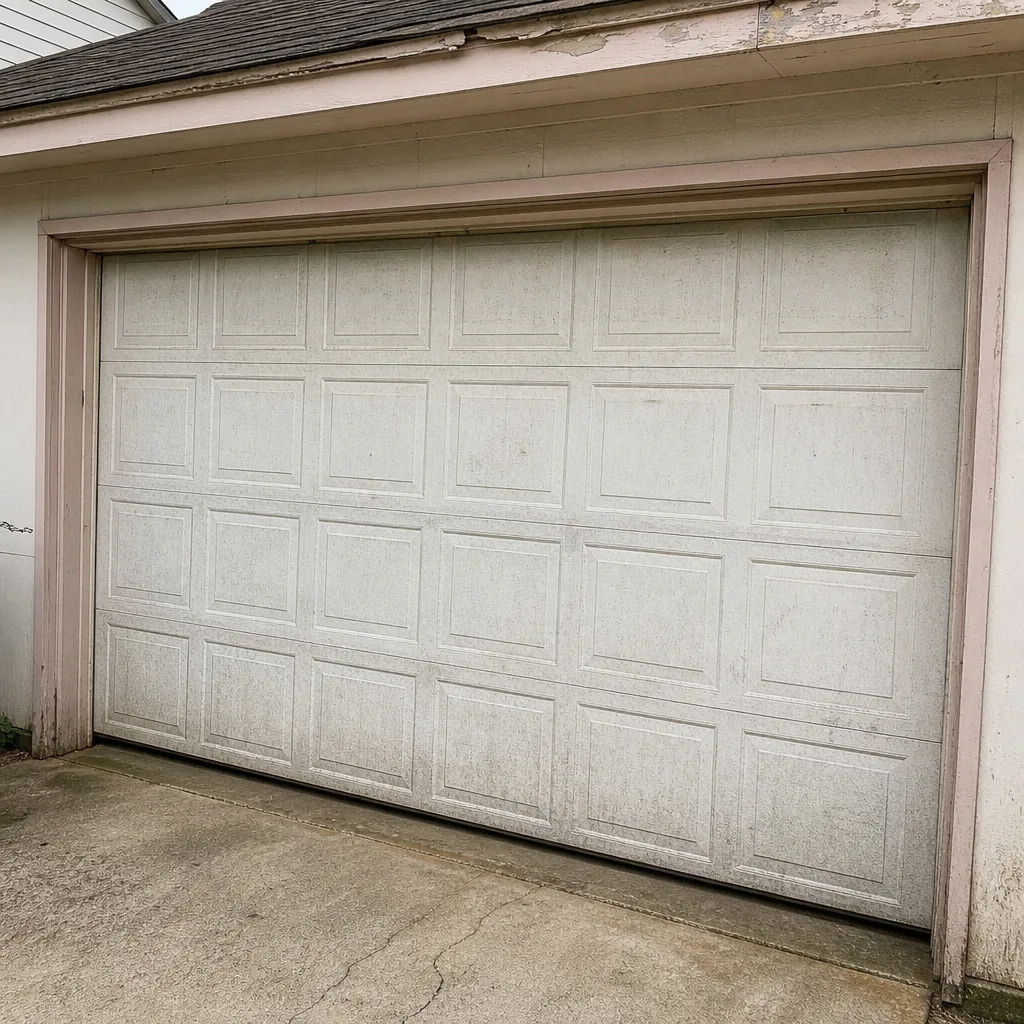
- Panels: The visible door sections. In Alief, steel and aluminum panels dominate, but you’ll still find wood composite doors on 1980s and 1990s homes around Sharpstown and the older sections of Alief ISD boundaries. Panels warp, delaminate, and rust, and they’re the single most expensive component to replace.
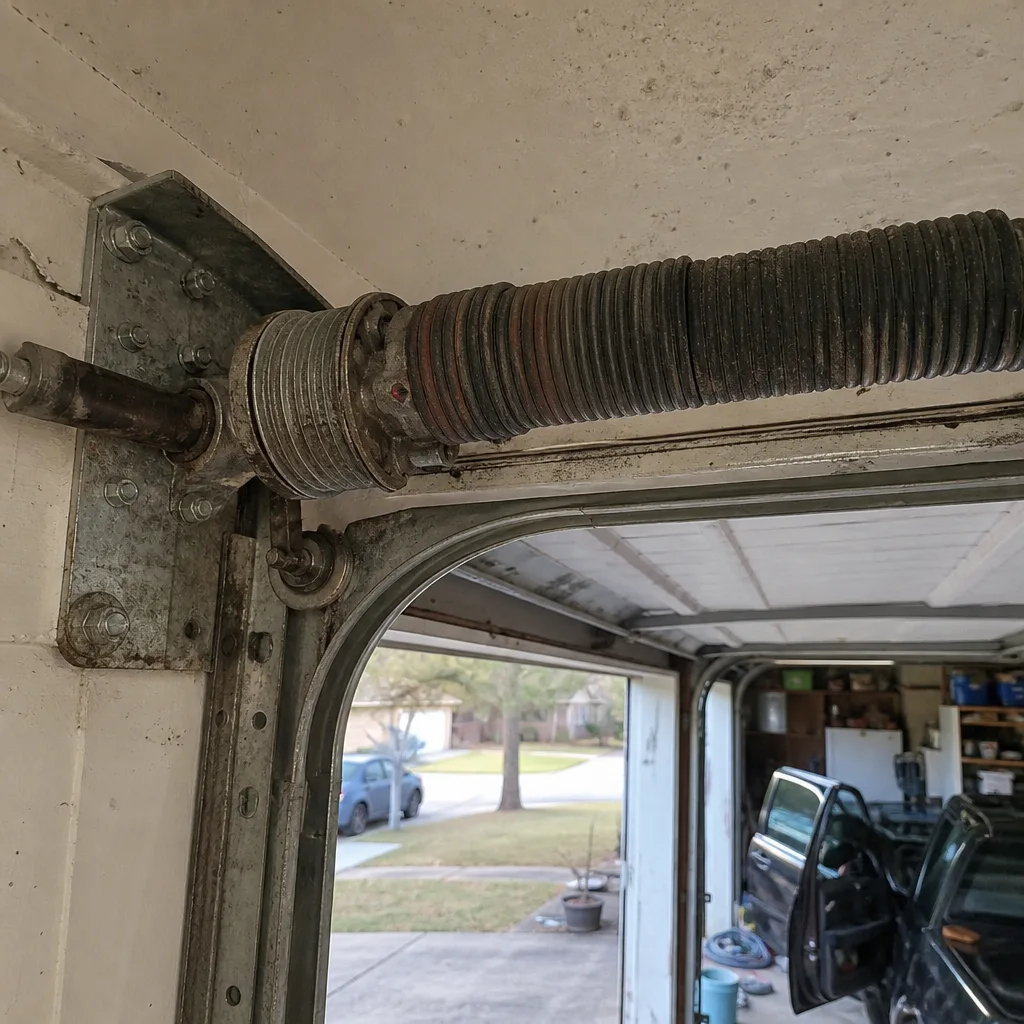
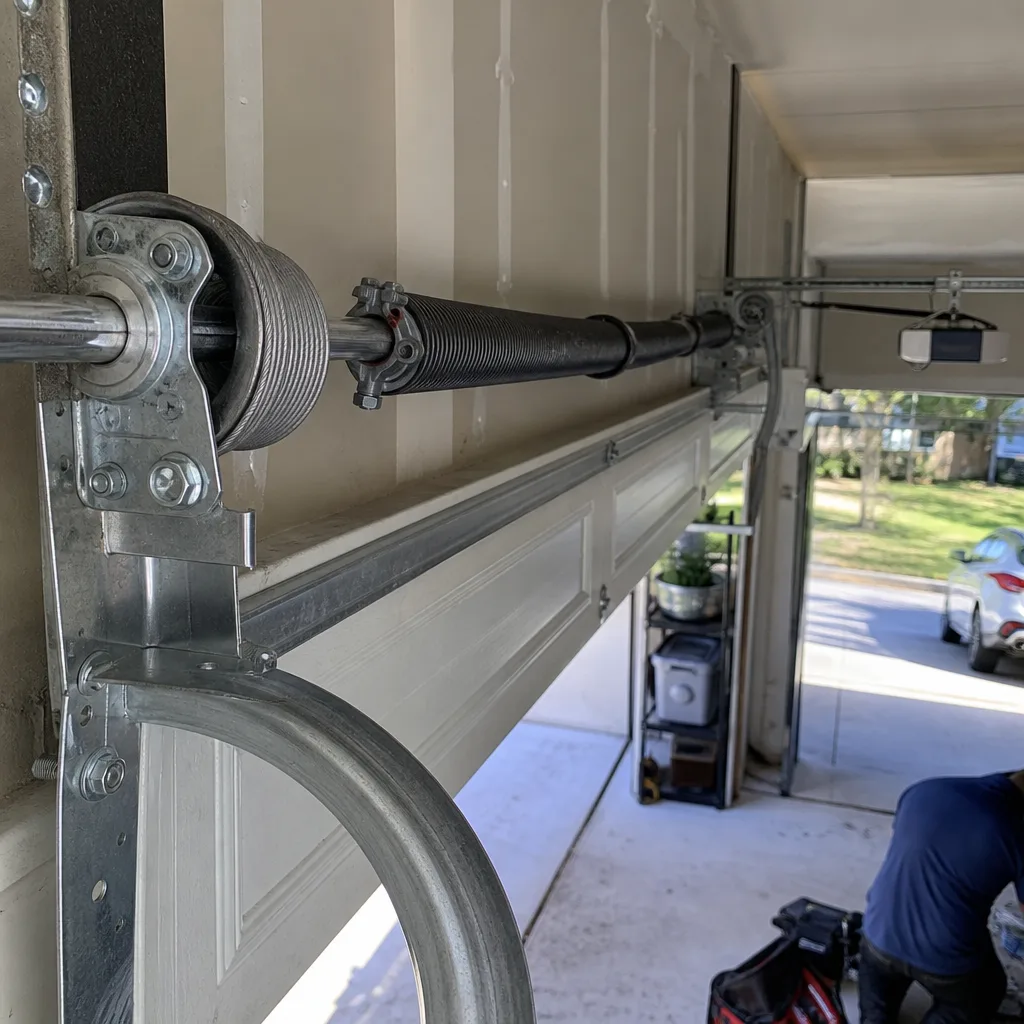
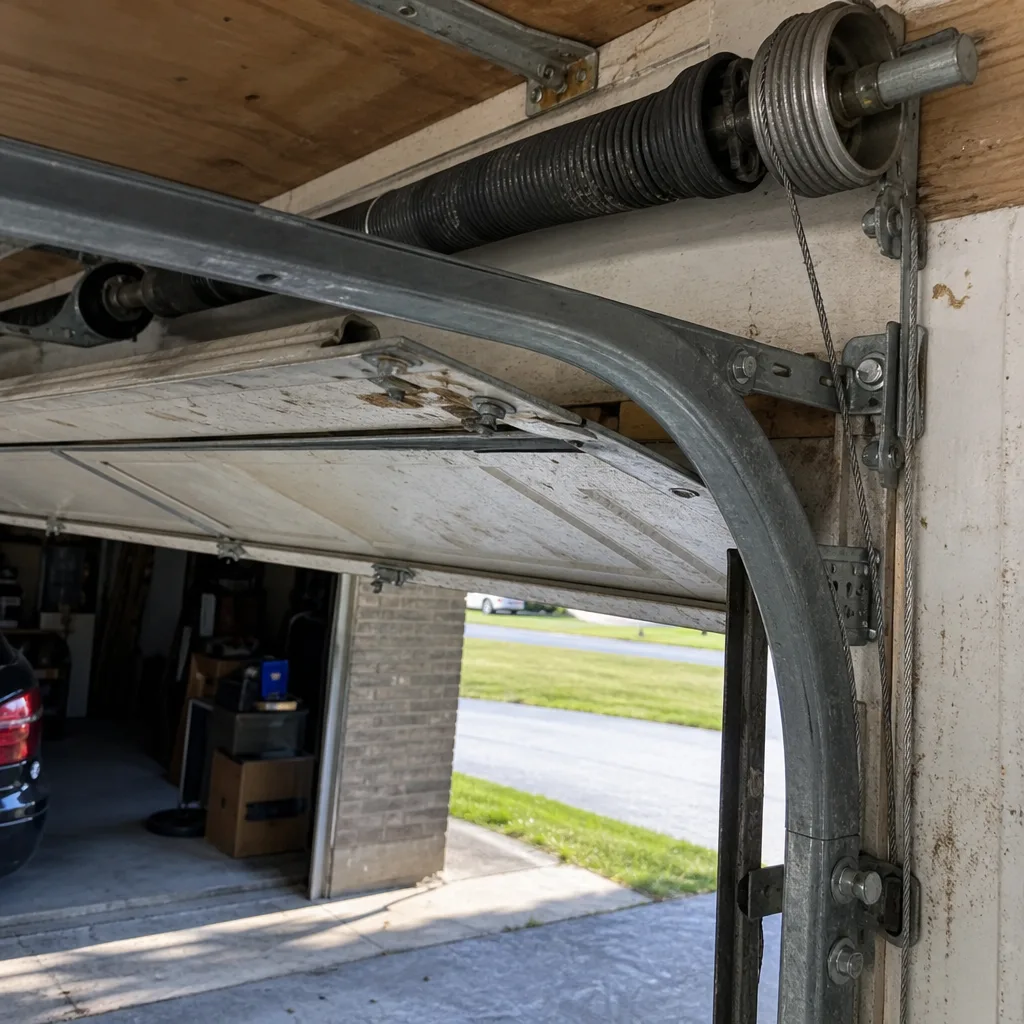
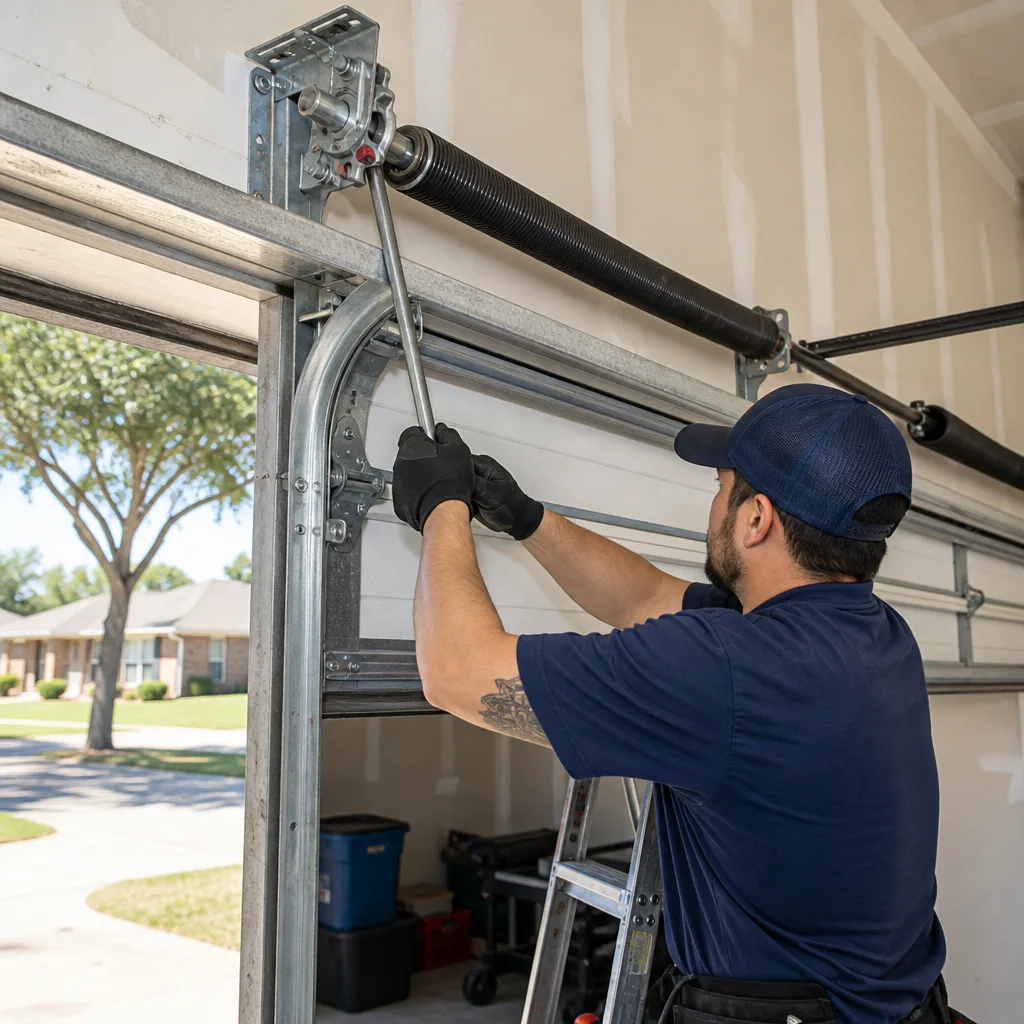
- Torsion springs: Mounted horizontally above the door opening on a steel shaft. They store the mechanical energy that counterbalances the door’s weight, making it feel light enough to lift by hand or with a small opener motor. Alief humidity shortens their life by accelerating internal coil corrosion.
- Extension springs: Found on older doors, mounted vertically along the side tracks. Less common today, but still present on many Alief homes built before 2000. They stretch and contract rather than twist.
- Cables: Aircraft-grade steel wire that runs from the spring assembly down to the bottom brackets, guiding the door and transferring lifting force. Frayed cables are a warning sign that the door is about to bind or drop.
- Rollers and tracks: Nylon or steel wheels that ride in vertical and horizontal tracks, steering the door through its full travel arc. In humid Alief air, steel rollers rust, nylon rollers crack, and tracks collect enough moisture-driven grime to cause binding.
- Opener: The motor unit on the garage ceiling, connected to the door by a rail, belt, chain, or screw drive. It’s a separate failure point from the mechanical door itself. A door that works fine manually but not with the remote is an opener problem, not a door problem.
In our experience across Alief, roughly 60 percent of “door won’t open” calls are actually spring or cable failures, not opener failures. Homeowners replace the opener, and the door still won’t lift. If you’re not sure which system failed, check whether the door opens manually with the red emergency release cord pulled. If it won’t move by hand, the problem is mechanical, not motorized.
We cover both sides of that line. Falcon Garage Door Repair works on door panels and hardware from Wayne Dalton, Clopay, Amarr, and Raynor, and opener systems from LiftMaster, Craftsman, Chamberlain, and Genie. One call covers the door and the opener, not two calls for two different companies.
How Gulf Coast Humidity Attacks Your Door
You’ve probably noticed something in a Alief garage in July: the air feels thick even with the door closed. That’s because slab-foundation garages here trap moist air, especially when they’re attached to the home and share wall cavities with the air-conditioned interior. The temperature differential between a cool indoors and a 95-degree, 80-percent-humidity garage creates condensation on metal surfaces overnight. That condensation is the enemy of every component on your door.
Here’s what actually happens over time:
- Torsion springs rust from the inside. Springs are made of oil-tempered steel coil. The oil coating wears off after the first few thousand cycles, exposing the coil to air. When that air is saturated with Gulf moisture, surface rust forms, then works into the micro-fractures that every spring develops under load. The spring doesn’t fail from the outside in; it fails from the inside out. We’ve pulled springs in Alief that looked fine on the surface but snapped clean because the interior coil had lost structural integrity.
- Bottom seals rot and split. The rubber or vinyl strip along the bottom of the door keeps water, insects, and rodents out. In Alief’s flood-prone drainage patterns, particularly around Brays Bayou and the Keegans Bayou watershed, standing water and high humidity accelerate the breakdown of that material. A 3-year-old seal in Alief looks worse than a 7-year-old seal in Dallas.
- Steel panels rust along the bottom rail. The bottom panel is the first to go because it’s consistently in contact with moisture, both from the air and from whatever accumulates on the garage floor. Bare steel exposed by scratched paint or dented surfaces rusts within weeks in this climate, not months.
- Opener circuit boards corrode. The logic board inside your opener is not hermetically sealed. It’s exposed to ambient air. In Alief, condensation forms on the board during the winter months when the garage interior cools overnight and warms during the day. Corroded solder joints cause intermittent operation: the opener works some days, fails others. It’s one of the most misdiagnosed problems we fix.
The practical takeaway: if your door hardware has been in service more than 8 years in Alief, assume humidity has already begun cutting into its remaining lifespan. A visual inspection that looks “fine” doesn’t tell you much. Springs hide their damage. Boards hide their corrosion. That’s why proactive replacement starts making sense as the system approaches the end of its expected cycle count, even if nothing has failed yet.
Repair vs. Replace: The Alief Cost-Benefit Math
This is the decision every Alief homeowner eventually faces. The door is 12 years old. Something broke. Now what? The answer depends on three factors: what failed, how much life remains in the other components, and what a replacement actually costs in the Alief market right now. For a detailed look at pricing, see our Garage Door Cost Breakdown: The Alief Homeowner’s Reference for 2026. Here’s the honest math.
When targeted repair is the right call:
- Single spring failure on a door under 10 years old. Replace the spring (and ideally its mate on double-spring doors, since both have the same cycle count), replace the cables if they show wear, and the system has another 7 to 10 years of life. This is the highest-value repair in the industry.
- Opener failure on a door in good mechanical condition. A new opener costs far less than a new door. If the panels, springs, and tracks are sound, replace the opener and move on.
- Roller or track wear. Nylon rollers are inexpensive and replaceable in under an hour. Track misalignment is often a bolt tension issue, not a component failure.
- Seal damage. A new bottom seal is a $50 to $120 repair, not a reason to replace anything else.
When replacement is the right call:
- Multiple simultaneous failures. If the spring snapped and the bottom panel is rusted through and the opener is 14 years old, the system is telling you something. At that point, you’re spending 60 to 70 percent of a new door’s price to extend the life of an old one by a few years.
- Structural rust on more than one panel. Surface rust can be painted. Rust that has perforated the steel cannot be repaired. A door that’s rusting through in Alief is a door that’s been losing the moisture battle for years.
- West-facing door with chronic heat damage. Alief afternoons in August put direct solar load on west-facing garage doors. Wood composite doors warp. Aluminum doors with dark paint absorb enough heat to stress the panel joints. If you’re repairing warped sections every couple of years, replacement with a heat-reflective steel door saves money over time.
- Door older than 15 years. Any single major failure on a system that old is a signal. The springs are on borrowed time if they haven’t been replaced already. The panels are rust-worn. The track hardware is fatigued. The opener is near end-of-life. Repairing one fail point just moves the next failure a few months down the road.
Falcon Garage Door Repair takes a repair-first approach. We’re not going to recommend a $2,800 replacement when a $300 spring repair restores the door to reliable service. But we’ll also tell you straight when the math stops making sense. That’s what a specialist does. Our garage door repair work across the area follows the same principle: fix what’s fixable, replace what’s exhausted.
Door Materials That Survive Alief Weather
If you’re shopping for a new door in Alief, the material decision matters more than the color. Here’s how the four main options hold up under local conditions.
- Steel (25 to 28 gauge): The most common choice, and for good reason. Galvanized steel panels resist rust as long as the paint layer stays intact. In Alief, that means touching up scratches quickly, especially along the bottom rail and around hardware penetrations. Steel holds its shape in heat, doesn’t warp in humidity, and offers good insulation in double-layer and triple-layer configurations.
- Aluminum: Lighter and naturally corrosion-resistant, but more prone to denting. Aluminum doors are a solid choice for wider two-car openings where weight is a factor. They don’t rust, but the panel joints can loosen under repeated thermal expansion and contraction, which Alief’s temperature swings accelerate.
- Wood composite: Traditional look, poor humidity performance. Composite doors absorb moisture through their seams, swell in summer, shrink in winter, and eventually delaminate. If you have a wood door in Alief and it’s still holding up after 15 years, you’re either lucky or the garage is unusually dry. Most aren’t.
- Vinyl: Often marketed as “maintenance-free.” Vinyl doesn’t rust and doesn’t warp, but it does fade under direct sun and becomes brittle in cold snaps. Alief’s occasional winter freeze events cause vinyl panels to crack at stress points, particularly around hinges and window inserts.
The short version: galvanized steel is the default choice for most Alief replacements. Insulated steel, with a polystyrene or polyurethane core, adds thermal resistance that matters more in this climate than most people realize. An attached garage in Alief transfers heat into the home’s adjacent wall cavities. A non-insulated door lets the garage interior hit 110 degrees or more in August, which makes the air conditioner work harder. A double-layer insulated door keeps the garage interior 10 to 15 degrees cooler. That difference shows up on the electric bill and it extends the life of everything stored in the garage.
Torsion Springs: The Component That Everything Depends On
If this guide has a villain, it’s the torsion spring. It’s the most dangerous component on the door to service and the most common failure point in Alief. Understanding how it works will help you understand why a professional repair is worth every dollar.
A torsion spring is a coil of high-carbon steel wire wound tightly under tension. It twists, not stretches, and that twisting creates torque on the shaft above the door. That torque is what balances the door’s weight. A standard two-car garage door weighs 130 to 180 pounds. Without the spring, you’re dead-lifting that weight. With the spring at correct tension, the door lifts with a few pounds of force.
Springs are rated in cycles. One cycle is one full open-and-close. The spring on a typical Alief garage door goes through 4 to 6 cycles per day, every day, year-round. That’s roughly 1,500 to 2,200 cycles per year. A standard 10,000-cycle spring lasts 4.5 to 6.5 years in Alief. A higher-rated 20,000-cycle spring lasts 9 to 13 years. Most builders install 10,000-cycle springs because they’re cheaper.
This is where Alief humidity makes things worse. Every cycle flexes the coil wire microscopically. Those flex points develop fatigue. In a dry climate, fatigue alone determines spring life. In Alief, moisture accelerates the fatigue process by corroding the steel at the stress points. A spring that would last 7 years in El Paso often fails at 5.5 years in Alief, all else equal.
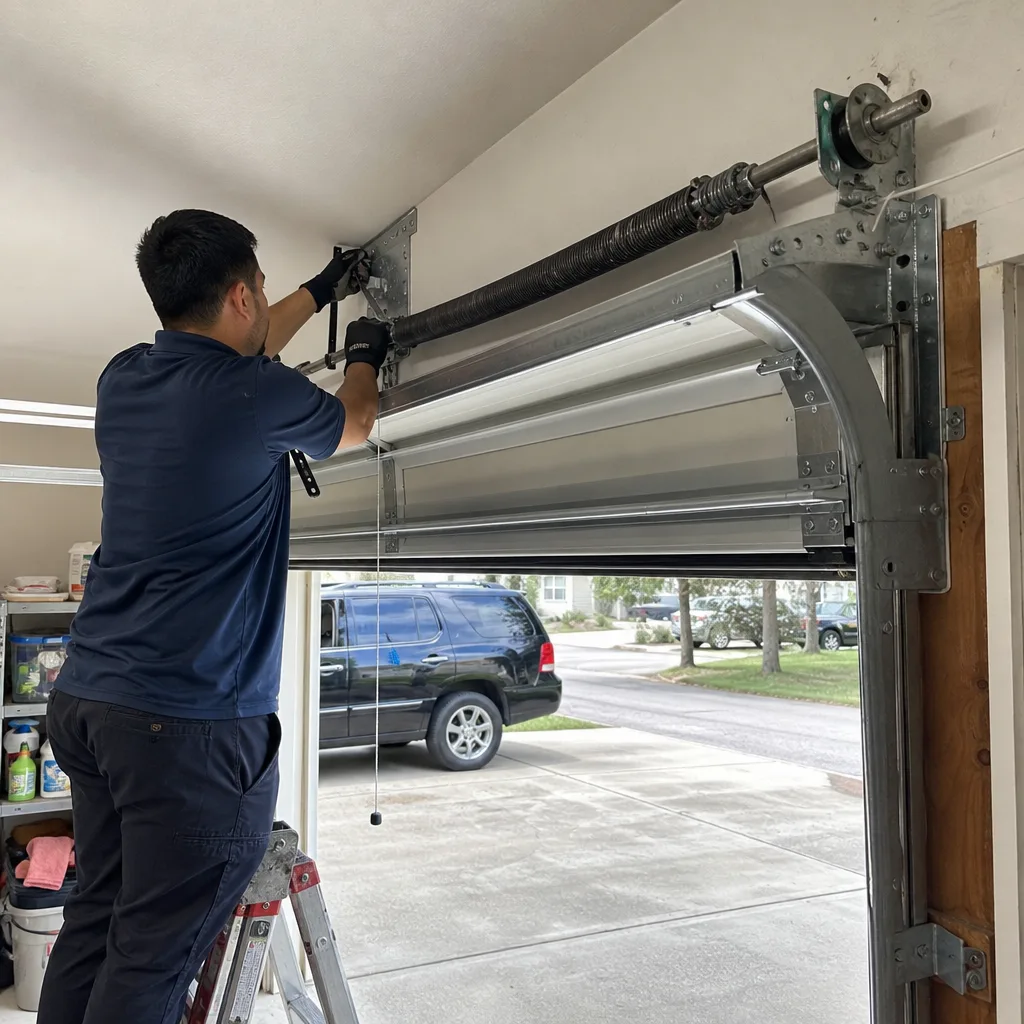
Professional note: torsion springs are under enormous stored tension. When one breaks, it releases that energy instantly. If you’re in the garage when it fails, it sounds like a gunshot and the spring can damage anything in its path. This is not a DIY repair. The tooling required – winding bars, tension gauges – isn’t in most homeowners’ garages, and the consequence of a mistake is serious injury. Springs are replaced by professionals for a reason.
We carry springs matched to the door’s weight, height, and cycle requirements, so a replacement spring is calibrated to the actual door, not a generic one-size-fits-most. For Wayne Dalton, Craftsman, Raynor, and other major brands, the spring specs differ by model and year. A specialist knows which spring belongs on which door.
Garage Door Openers in a Humid Climate
The opener is the appliance most Alief homeowners interact with daily and understand the least. Here’s what you need to know about opener failure modes in this climate and what to look for when replacing one.
The biggest misconception is that a garage door opener is a simple motor. It’s not. A modern opener is a motor, a logic board, a safety sensor system, a drive mechanism, and increasingly a wireless receiver for smart home integration. Five failure points, any one of which can disable the unit.
In Alief specifically, we see these failure patterns:
- Logic board corrosion: The number one Alief-specific failure. Condensation forms on the board during humid nights and mild winters. Solder joints corrode. The symptom profile is classic: opener works intermittently, then fails entirely. Sometimes the remote won’t pair. Sometimes the wall switch works but the remote doesn’t. Replacing the board is possible on some models but usually costs 60 to 70 percent of a new opener, which makes replacement the smarter financial move.
- Drive gear wear: Chain and screw drives use plastic and metal gears that strip over time. The motor runs but the door doesn’t move, or moves with a grinding noise. Belt drives are quieter and last longer, but cost more upfront.
- Safety sensor misalignment: The photo-eye sensors at the bottom of the door track can be knocked out of alignment by a bump from a car, a bicycle, or a trash can. The door reverses when closing. This is usually a simple fix: realign, clean the lens, verify the wiring.
- Capacitor failure: The start capacitor that gives the motor its initial jolt wears out. The motor hums but doesn’t start, or starts slowly. This is a repair part available for many LiftMaster and Craftsman models, but the age of the opener usually determines whether a capacitor replacement or a full opener replacement is the better call.
When replacing an opener in Alief, consider a belt drive with a DC motor. Belt drives are quieter and have fewer metal-on-metal wear points, which matters in a humid environment where lubrication breaks down faster. DC motors are more energy-efficient and often include soft-start and soft-stop features that reduce stress on the door panels and hardware. For opener repair in the Alief area, the same logic applies: fix the specific failure when the unit is otherwise healthy, replace when multiple systems show age.
Security and Energy Efficiency in Slab-Foundation Homes
Most Alief homes are built on concrete slab foundations with attached garages that share walls with the living space. That architectural fact creates two specific concerns that don’t apply in other parts of the country: heat transfer and security integration.
The heat transfer problem is straightforward. The garage door is the largest uninsulated surface on most homes. In a slab-on-grade house, the concrete floor absorbs heat all day and radiates it upward, while the door absorbs solar radiation and conducts it inward. The garage becomes a heat battery. When the garage shares a wall with a bedroom or a living room – common in Alief floor plans – that heat migrates through the wall cavity into the conditioned space. A well-insulated door, kept properly sealed along the bottom and sides, reduces that thermal load measurably. It’s not an HVAC fix, but it’s a meaningful part of the total envelope.
The security concern is more specific. The garage door is the single largest moving entry point on the home. It’s also the one most homeowners leave vulnerable in predictable ways:
- Opener remotes left in cars parked in the driveway. A car break-in in Alief doesn’t just cost a window; it potentially hands a thief access to the garage, and through the garage, the home. Use the opener’s keypad or a smart opener with phone control, and keep the remote out of plain sight.
- Emergency release cord accessible through the top panel gap. A coat hanger pushed through the gap between the top of the door and the frame can snag the emergency release, disengaging the opener and allowing the door to be lifted manually. Shield the release or zip-tie it closed. We can show you what that looks like.
- The interior door from garage to home left unlocked. In a break-in scenario through the garage, the interior door is the last line of defense. It should be solid-core, properly fitted, and locked.
The point: your garage door isn’t just a door. It’s part of your home’s security perimeter. It should be treated accordingly. For steps to keep your door reliable during severe weather or power outages, see our Garage Door Emergency Preparedness Guide for Alief Homes. A well-maintained door and opener that close fully, seal along the bottom, and lock out at the right points is a meaningful security upgrade by itself.
Common Mistakes to Avoid
- Replacing the opener when the door itself is the problem. If the door won’t move manually with the release cord pulled, a new opener won’t fix it. We see this several times a month in Alief: a homeowner installs a $400 opener, and the door still won’t lift because the spring snapped.
- Ignoring a snapped spring and forcing the door open. A door with a broken spring weighs 150 pounds dead. Forcing it open by hand or with the opener strains every other component and can pull cables off the drums, causing the door to drop when least expected.
- Applying WD-40 to everything. WD-40 is a penetrant and water displacer, not a long-term lubricant. On garage door rollers and hinges, it washes out existing grease and leaves the metal unprotected. Use a silicone or lithium-based lubricant on moving metal parts, and keep WD-40 away from the torsion springs.
- Buying the cheapest replacement spring online. A spring that isn’t matched to the door’s exact weight, height, and drum type will either not lift the door correctly or will snap prematurely. Precision matters. A spring from a generic retailer is a gamble.
- Painting over rust without treating it. Painting over active rust in Alief just seals the moisture in. The rust continues underneath, and the paint bubbles off within a year. The rust must be removed or neutralized first, then primed, then painted.
- Deferring maintenance until something breaks. In a climate this aggressive on metal, the cheapest maintenance is inspection. Catching a frayed cable before it snaps, a cracked roller before it binds, or a spring that’s reaching its cycle limit before it fails prevents the cascading damage that turns a $150 fix into a $1,500 problem. Our installation work always includes a full-system check for this reason.
When to Call a Professional
Some garage door tasks are DIY-friendly: tightening hinge bolts, cleaning tracks, replacing a wall button battery, or lubricating rollers. These are safe, low-stakes jobs. For help deciding what you can handle yourself, read our DIY vs Professional Garage Door: The Alief Homeowner’s Decision Guide. Everything else involving spring tension, cable routing, or opener electronics should go to a professional. A torsion spring under tension carries enough stored energy to cause severe injury if mishandled. Cables under load can snap and strike. Opener logic boards are easy to damage with static discharge. If you’re not certain what you’re looking at, the correct move is to call someone who is.
Falcon Garage Door Repair offers free estimates in Alief. Call (833) 589-6911. We’ll diagnose the system, give you the price upfront, and make the repair only if you approve it. No surprises, no pressure. That’s the whole job.
Frequently Asked Questions
Standard 10,000-cycle torsion springs last 4.5 to 6.5 years in Alief under normal daily use, with humidity accelerating internal corrosion. Higher-rated 20,000-cycle springs last 9 to 13 years. If your springs are over 7 years old, they’re on borrowed time. Call (833) 589-6911 for a spring inspection and a free estimate on replacement.
Single torsion spring replacement in Alief typically runs $180 to $340 installed, depending on door weight and spring cycle rating. Double-spring systems run $280 to $520. These are market-relevant ranges for the Alief area; your exact price depends on the door. We quote the full price before any work begins, so there’s no surprise on the invoice.
Yes, if the panel is still manufactured and the rest of the door is in serviceable condition. For most major brands, including Wayne Dalton and Amarr, individual panels are available. If the door is older than 12 years or has multiple damaged panels, replacement often makes more financial sense. We’ll tell you which is the better call for your specific door.
Intermittent opener operation in Alief is most commonly caused by logic board corrosion from humidity, a failing capacitor, or a safety sensor that’s losing alignment. These are all diagnosable in a single service visit. Intermittent operation rarely fixes itself; it usually progresses to full failure within weeks or months.
Once per year for a visual inspection and lubrication, and a closer inspection every 2 to 3 years to check spring wear, cable condition, and seal integrity. In this climate, annual service catches the problems that humidity accelerates. The cost of an inspection is a fraction of the cost of a cascade failure.
We work on openers from LiftMaster, Craftsman, Chamberlain, and Genie, and doors from Wayne Dalton, Clopay, Amarr, and Raynor. If you own a system from one of these brands, we’re already familiar with it. That means faster diagnosis and the right parts on the truck, not ordered and re-scheduled.
The Bottom Line
A Alief garage door lives a harder life than its counterparts in drier, cooler cities. Humidity accelerates spring corrosion, seal rot, panel rust, and opener board failure. The components don’t all age at the same rate, which is why targeted repair makes sense when one thing fails on a young system, and full replacement makes sense when multiple systems are exhausted. The smartest money you’ll spend on your door is the inspection that catches a failing spring before it fires, a frayed cable before it snaps, and a corroded board before it leaves you locked out of your garage at the worst possible time. If it’s been more than a year since anyone looked at your system, it’s time. Call (833) 589-6911 or visit our Falcon Garage Door Repair home page to set up a free estimate.
Written by the team at Falcon Garage Door Repair, serving Alief since 2018.
See the difference
 Before
 After
 Before
 After
 Before
 After